
What you look at will eat you alive. That’s what Daniel Kaluuya and Keke Palmer’s characters realize in Jordan Peele’s new thriller, “Nope,” which was released to theaters last weekend.
Peele’s movie is enigmatic and highly wrought and fun, the fictional blend of a tragic incident in the entertainment industry with the story of two siblings squaring off against an unidentified flying object in the wake of losing their father.
And in “Nope,” seeing is eating, and so if you’d like to see how this theme plays out in Peele’s clever screenplay and mise en scene, keep reading. Proceed only if you’ve seen the movie because spoilers abound.
There are six title cards arranging the movie, beginning and ending with “Nope” title cards.
For example, the movie begins with audio from a recording of the fictional TV show, “Gordy’s Home,” which reveals a chimpanzee, Gordy, bloody and frenzied, having beaten a young woman before apparently breaking the fourth wall.
The movie cuts to the Haywood Hollywood Horses ranch where Otis Haywood Sr. (Keith David) and his son, OJ Haywood (Kaluuya), make a living by raising stunt horses for entertainment industry projects.
FADE TO BLACK (WITH ORANGE GLOW)
TITLE CARD:
“NOPE”
(The movie’s six title cards are, Nope, Ghost, Clover, Lucky, Jean Jacket, and Nope.)
Our first glimpse inside the monster Jean Jacket occurs after the “Nope’ title card, as the opening credits roll—and our view of the monster’s square aperture is initially bewildering: at first I believed it was a projection booth, seeing as how Muybridge’s 1878 “The Horse in Motion” clip was playing beyond it. Later, however, we learn that Jean Jacket’s eye also is its mouth.
I-SEE
Eyes pop out throughout the movie.
And it’s crucial to understand this motif as reflecting a broader theme rather than simply a denunciation of consumerism in the motion picture industry or media entertainment. (Though, obviously, that’s a part of it, considering the movie’s main character is named “OJ,” a purposeful allusion to the infamous O.J. Simpson murder trial which had all of us glued to couches and barstools in the 1990s.)
Toward the end of the “Lucky” segment, OJ realizes Jean Jacket will not eat you unless you look at it. (The decoy horse from Jupiter’s Claim gets “eaten” because its red eyes are looking up.) After voicing this insight about making eye contact with the monster, OJ accompanies his sister, Emerald (Palmer), and their new friend, Angel (Brandon Perea), to an apartment where Angel and Emerald trade out natural visual sensation for virtual reality headsets and marijuana blunts.
But the motif is everywhere: Angel drives a van playing Corey Hart’s “I Wear My Sunglasses at Night,” a 1980s paean to…romantic suspicion? deliberate blindness?; a sign “Imagen” stands outside the seafood restaurant when OJ suggests “catching” Jean Jacket; and when the Bonnie Clayton star shows up on the movie set for the commercial, the director’s creepy invitation is for everyone to “look at all that.”
My sister pointed out that the aggressive blooming of Jean Jacket’s eye-mouth sounds like the flash of a camera and looks like it, too. Remember also the flower blooms and UFO on Ricky “Jupe” Park’s (Steven Yeun) red cowboy suit.
But the names of characters and their costumes cleverly expand this eye motif.
Recall how the tech geek named Angel watches them from afar, monitoring the Haywood’s camera feed. Initially, I could not decipher why it was significant that Angel worked for Frye’s Electronics until another possibility emerged: he worked for Fr-eyes Electronics, which Frye’s Electronics store facade features some kind of wrecked space vessel.
Too far? I think not. At the Jupiter’s Claim amusement park, during Jupe’s StarLasso Experience, the camera dwells on a collection of ICEE machines, and not only to denote when electrical power fails and returns—they are not ICEE machines, but “I SEE” or “EYE-SEE” machines.
And consuming and seeing go together. Patrons consume “I SEE” drinks from a concessions stand next to a vendor’s booth selling alien costumes branded as Jupe’s “Viewers.” The whirlwind vented from Jean Jacket’s eye-mouth inhales horses and people. The cinematographer watches animal world violence while thinking fondly of his lemon tart baking in the oven. The female team member at Frye’s Electronics (Barbie Ferreira) eats chips from a snack bag and watches Angel watching the camera feed while Emerald also is eating from a snack package of Sour Patch Kids. Emerald even hurls Sour Patch Kids in an effort to knock off a praying mantis blocking the camera’s view.
At the seafood restaurant at the end of the “Lucky” segment, Angel and Emerald only want to talk about their food, their fish sandwiches—not about Jean Jacket. Meanwhile, two gangs of youthful athletes stare off at one another and throw hands.
‘BAD MIRACLE’
Emerald’s reluctance to speak about Jean Jacket at the restaurant is quite telling in another way, too.
“Nobody wants to talk about that,” she says, a nod to the grief over their father’s death that is only subtly—or even symbolically—addressed in the movie.
In connection to the eye motif, Otis Sr. dies from what doctors call a “bad miracle,” a nickel blasted from the sky through his eye. (In one interview, Peele said the working title for his movie was “Little Green Men,” a reference not only to aliens but also to the men whose faces adorn U.S. currency.)
OJ HAYWOOD
“Is there a bad miracle? Is there a word for it?”
EMERALD HAYWOOD
“Nope.”
Emerald’s response to OJ is both an answer in the negative as well as the identification of a “bad miracle” as this thing we call a “Nope,” if you will—the first “nope” being the nickel through Otis Sr.’s eye six months ago. (This makes more sense upon remembering that the title card preceding Otis Sr.’s death is “Nope,” and each of the segments in Peele’s movie feature such “nopes,” or bad miracles.)
At the movie set, one of the assistant directors tells OJ that he knows the death of Otis Sr. six months ago left a “big hole,” which “hole” only ever reappears in connection to Jean Jacket’s eye-mouth “hole,” which also first arrived six months ago.
And so, the movie’s climactic showdown is one in which OJ and Emerald stand on opposite sides of Jean Jacket. At the end, symbolically undoing Otis Sr.’s earlier decision, OJ lets Emerald “have” Jean Jacket, and she trains him to follow her to Jupiter’s Claim where she destroys him and takes his picture.
PREDATORS
Despite the siblings’ victory over Jean Jacket, there is, I think, a tragic note to the ending, seeing as how OJ is the one who remains within the Jupiter’s Claim frame for “Out Yonder” (being “out yonder” like the deceased Otis Sr.?) while Emerald gives in to her destructive predator instincts by trying to “shoot” a photo of Jean Jacket.
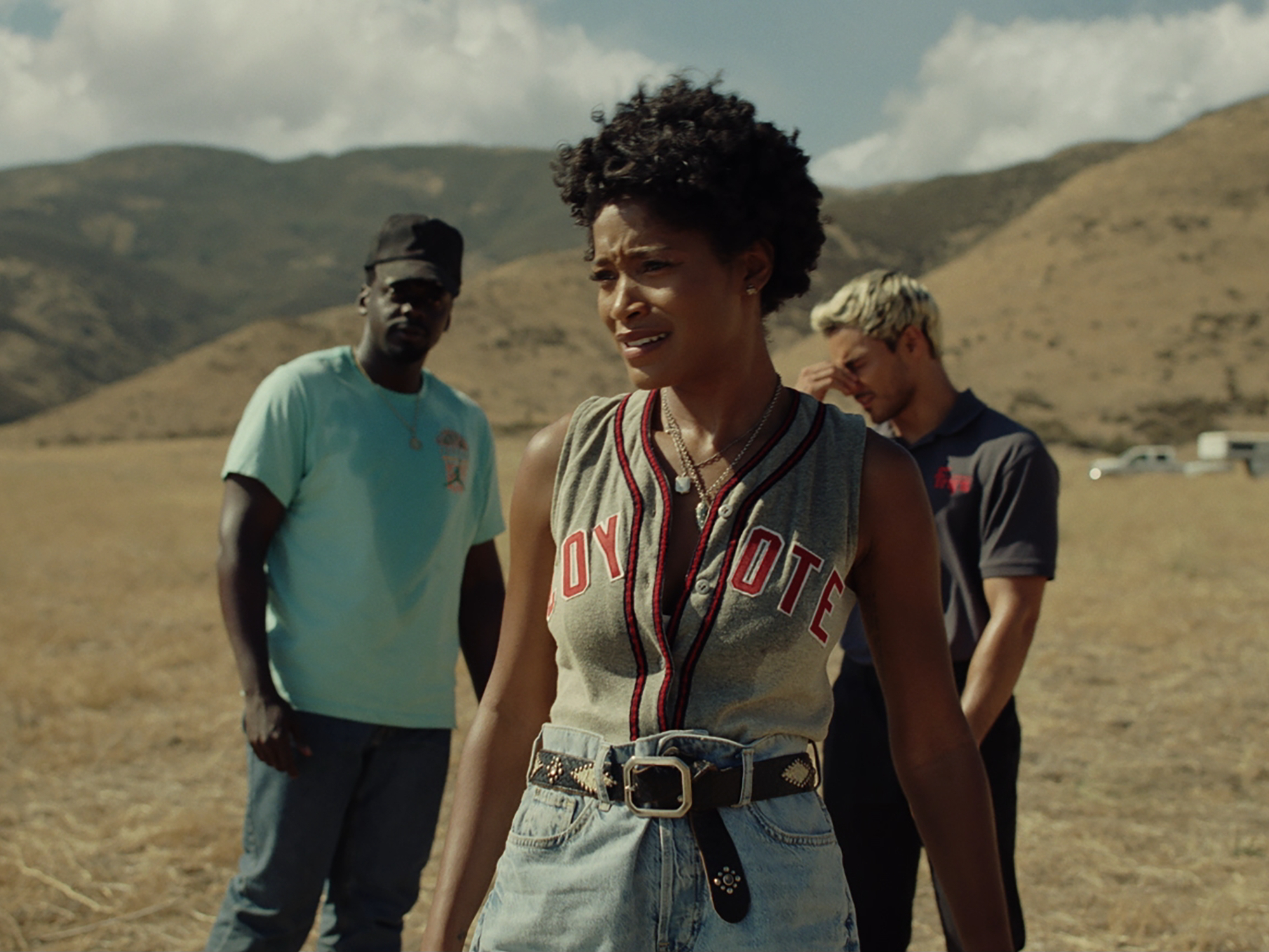
For example, early on in the movie, Emerald wears a baseball jersey shirt that says, “COYOTE,” in red letters. Later, she wears a band t-shirt for The Jesus Lizard, featuring the band’s name on the back and the lusty bulging eyes of the Big Bad Wolf on the front.
Prior to beginning their capture of Jean Jacket at the ranch, Emerald sets the needle on a record of Exuma’s “Exuma, The Obeah Man,” which song begins with a wolf howling, mind you (!). And she is seen with antlers on the wall behind her as she looks out the “Jean Jacket” window. That particular antlers trophy was not present earlier in the movie when she looks out the window and speaks bitterly of Otis Sr.’s reneging of his promise to let her train the horse, Jean Jacket.
In case you miss the connection between lone wolf Emerald and predators, the movie features another similar character type: the cinematographer who goes by the name of Antlers Holst (Michael Wincott).
Antlers spends his spare time watching film clips of the eyes of predatory creatures or film clips of predators tearing at other predators. He can’t turn his eyes away from the violence onscreen.
He’s a hunter. When planning to capture Jean Jacket, he tells OJ to break him, and “I’ll get the shot.” He even brings his own gear and sets up under a hunting blind of camouflaged netting.
JUPITER’S CLAIM
Antlers and Emerald each want the “impossible shot,” the “Oprah shot,” the latter of which phrases represents a desire for fame—which Antlers Holst warns Emerald against when he discourages her from wanting to stand “at the top of the mountain and all eyes are on you.” In other words, greed is the motivation for getting the “impossible shot.”
Antlers and Emerald also are each portrayed similarly to Jupe and his efforts to regain immortality at Jupiter’s Claim. (In an amusingly ironic remark, OJ says that Gold Rush, the amusement park, went bankrupt.)
When OJ tries to negotiate business with Jupe at his Jupiter’s Claim office, OJ gets frustrated whenever Emerald points out some of Jupe’s “Kid Sheriff” or “Gordy’s Home” paraphernalia, but Jupe isn’t put out—not in the least. He’s delighted to be seen.
In his StarLasso Experience shows, Jupe goes so far as to claim the aliens—the Viewers (a nod to the audiences of his movie and television appearances)—obviously trust him or else they would have eaten everyone already. (“Trained animals are unpredictable,” says Jupe’s wife, Amber [Wrenn Schmidt], as Jean Jacket’s whirlwind descends.)
There are three characters viewed within a close-up from the same overhead camera angle: Jupe, Antlers, and Emerald. Otis Sr. is not seen from above when the nickel strikes him, and the camera remains at ground or eye level with Angel and OJ whenever Jean Jacket is around.
But the camera angle captures Jupe looking up as Jean Jacket inhales him, Antlers as he is inhaled, and—finally—Emerald in the Jupiter’s Claim village as she tries to shoot a photo of Jean Jacket from the Winking Well camera.
The movie ends with a shot of the shot which Emerald took of Jean Jacket as he took a shot at Balloon Jupe. She succeeds in getting the “impossible shot,” the “Oprah shot,” but all she’s actually done is surrender to her own wolfish greed.
The movie-ending photograph from the Winking Well Camera is the same camera angle as the “Kid Sheriff” movie poster on Jupe’s office wall. Thus, Emerald gets her own movie poster, her own paraphernalia from an experience she’ll likely monetize, just like Jupe.
‘GORDY’S HOME’
One of the persistent questions arising in connection to “Nope,” and possibly the first question on each viewer’s mind while watching the movie, is: What’s the point of the “Gordy’s Home” incident?
The “Gordy’s Home” segment is the whole movie in miniature. So, in the “Gordy’s Home” segment that begins the movie, the father figure on the TV show fails to provide a gift, just as Otis Sr. failed to render the horse Jean Jacket as a gift to his daughter.
Moreover, the son in the TV show forgets his lines (just like OJ at the movie set when asked to head up a safety meeting) and can only give an apparently small gift whereas the sister, Mary Jo, brings in a large gift, a big box of balloons that makes a mess of everything—just like Emerald.
Remember, too, that the Haywood mother is completely missing from the movie, except for a few seconds when we see her portrait on a Haywood home wall while the UFO Jean Jacket expels human filth over the house.
And in the “Gordy’s Home” incident, the only characters seen on the set are Young Jupe, Mary Jo, and the father—who dies when Gordy bashes in his head. Just as in “Nope,” the mother in the “Gordy’s Home” set is mysteriously absent.
Consider this: On the “Gordy’s Home” set, Young Jupe sits beneath the dining room table, with a tablecloth veil hanging over the table’s edge. Many people have suggested that perhaps Gordy did not attack Young Jupe because the tablecloth veil “protected” him by impeding the chimpanzee’s vision. Sure.
EMERALD
But what’s more significant here is the color of the tablecloth veil: green.
Young Jupe witnesses the horror of the incident and meets the crazed Gordy, face-to-face, through a green veil, foreshadowing Jupe’s transfiguration of his traumatic experience as an opportunity to make more green. (He charges a couple $50,000 to stay in his secret room of “Gordy’s Home” paraphernalia.)
When Jupe tells the story about the fictional Saturday Night Live skit lampooning the “Gordy’s Home” incident, he says—without any self-awareness—that Chris Kattan, playing Gordy, “is killing it on stage.”
And who else is green? Emerald, that’s who—the woman who treats Haywood Hollywood Horses as her side-hustle and promotes her other gigs, who wants to score $100,000 or more by selling photographs and videos of Jean Jacket, &c.
And where do Emerald and Jupe live? Aqua Dulce Canyon—“aqua dulce” being a greenish color. They live on a ranch where the father, Otis Sr., was so violently preoccupied with making money at the ranch (“Just execute,” he says) that he prioritized getting that green on “The Scorpion King” job ahead of honoring a promise to his daughter. (What kills Otis Sr.? Money.)
And what else is green? Jean Jacket’s eye-mouth, the same flares of green through which Jean Jacket views Balloon Jupe prior to consuming him in the clouds.
Just like Mary Jo Elliot in the “Gordy’s Home” incident, Emerald releases a balloon (Balloon Jupe) that pops. In each case, balloons popping results in someone’s death. (Young Jupe and Gordy share the world’s first “explosive fist bump,” which explosive fist bump is re-enacted when Jean Jacket and Balloon Jupe meet in the clouds; in the “Gordy’s Home” incident, Young Jupe and Gordy never actually bump fists, and Jupe’s wife, Amber, massages the pressure point in his hand valley point prior to public performances.)
The obsession with money is subtly signified when OJ & Crew plan their capture of Jean Jacket using pieces from that embodiment of cutthroat capitalism, the classic Monopoly board game: Top Hat, Racecar, Horse and Rider, Thimble, etc. (What Monopoly pieces are missing? One of them is the shoe.)
At the end of “Nope,” Emerald gets the green-eyed monster eating the Jupe kid whose green-fixation has ballooned. The movie appears to end on a satisfying and apparently hopeful note—monster dead, yeah!—but the implication is that Emerald will ultimately “get got,” too.
Just like Mary Jo Elliott in the “Gordy’s Home” incident, Emerald releases a balloon and will be ultimately disfigured (by her greed).
SPECTACLE
Where does that leave OJ? Good question. Throughout the movie, OJ—sharing a name with a suspected murderer—has a devil or demon vibe: he wears a shirt with the words “Killer Grip,” which is not just a movie set term since the same black t-shirt features a red and diabolical-looking bison or bull on the back. Later, he wears a “Scorpion King” sweater. (We are introduced to OJ in the early morning darkness as he sinks two metal hay hooks into hay bales beneath a window shaped like Jean Jacket’s eye-mouth.)
At the end of the movie, however, OJ is seen within the Out Yonder picture frame, atop his horse and surrounded by mist. Some have noted the similarity between the final shot of OJ and the Haywood jockey from the Muybridge clip.
Right. And but why mist? Because, throughout the movie, Jean Jacket makes his appearances in clouds and mist.
Jean Jacket, in other words, is an angel. Search the internet for images of a “biblically accurate angel,” and you’ll find plenty of artistic representations of Jean Jacket angels based on exact descriptions in biblical texts, each resulting in something not too far removed from Sheb Wooley’s “one-eyed, flyin’ purple people eater.”
The representation of Jean Jacket, in his final evolved form, as one such “biblically accurate angel” helps make more sense of the Nahum 3:6 quote which opens the movie: “I will cast abominable filth upon you, Make you vile, And make you a spectacle” (New King James Version?).
At the two StarLasso Experience shows featured in the movie, Jupe invites people to enjoy an “absolute spectacle.”
And perhaps there are other connections between “Nope” and Nahum 3—like “galloping horses” and “a great number of bodies, countless corpses,” but it appears that Jean Jacket’s flushing of people’s pocket items, shooting people with coins, inhaling cinematographers and actors and one-eyed paparazzi, is all part of casting the “abominable filth” of sinners back at them.
The movie monster might just be an angel commissioned with executing divine justice (hence his assistance from a praying mantis, which OJ says he hasn’t seen “in a minute”). Or, considering how the tech geek Angel shows up for the final “battle” wearing a t-shirt that says “Earth” and depicts a serpent coiled around the earth, Jean Jacket might just be a serpent in whose intestines people are squeezed and slowly dissolved (terrifying, even nauseating to see).
But the one person who makes an agreement with this “serpent/angel” Jean Jacket, is OJ—the demonic horse boy. OJ not only survives the Jean Jacket incident but—unlike the cast of “Gordy’s Home” or anyone else in Aqua Dulce—he voluntarily sacrifices himself as bait for Jean Jacket or seeks to rescue the paparazzi biker even at great risk to his life.
So, after the movie’s events, OJ the demonic horse boy arrives at Jupiter’s Claim, and he is, as Jupe would say, “different.” OJ sits on his horse in mist, just like Jean Jacket—just like an angel.
Shortly after the movie’s opening, the serpent/angel Jean Jacket is looking at Muybridge’s “Horse in Motion.”
And who else watches Muybridge’s “Horse in Motion”? Emerald.
Finally, at the movie’s closing, the new monster, Emerald, views the new horse in motion, the new angel, OJ, through the Out Yonder frame.
